Match the sensor to the portion
Check where the sensor sits and how deeply it must be inserted. A short sensing area near a slender tip helps with flat foods. A longer sensing section needs enough food around it to produce a meaningful reading. An impressive accuracy claim is of little use if half the measuring area sits outside your usual portions.
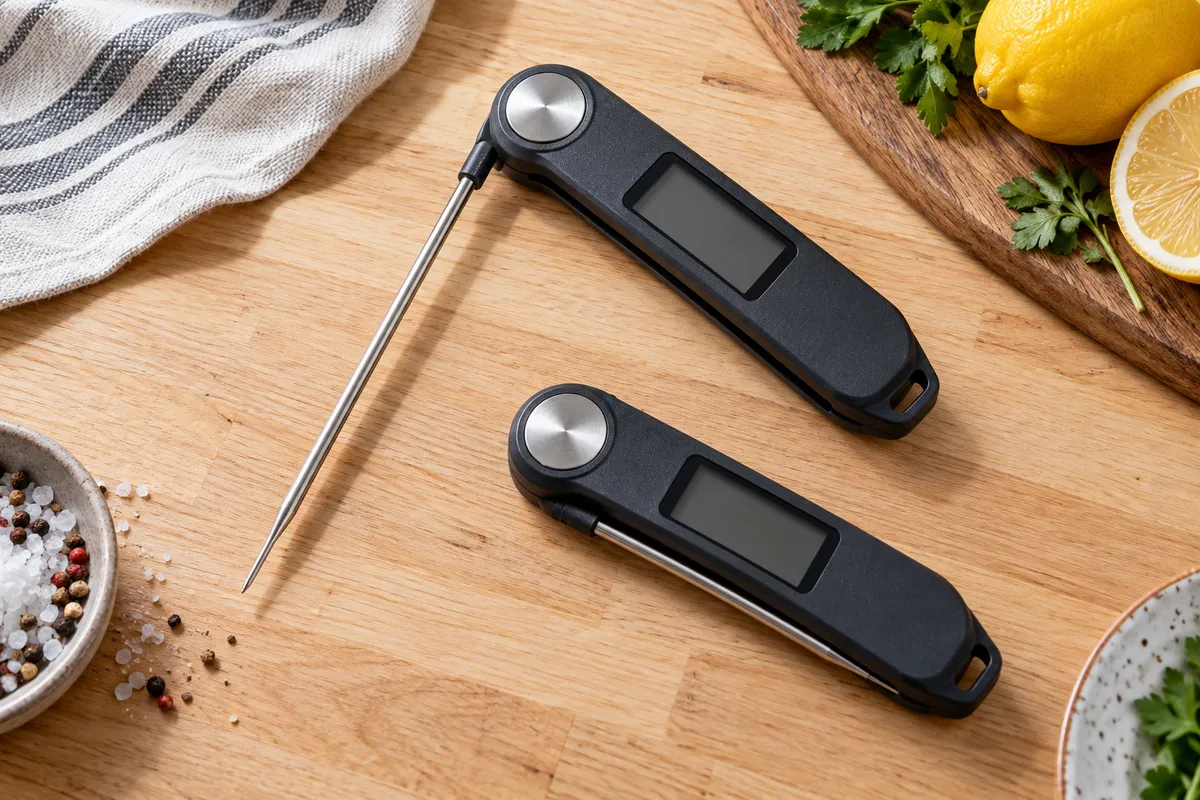
Consider probe length and handle shape too. You need to reach the correct location without holding your hand unnecessarily above the heat. A folding probe may simplify storage and viewing, but its mechanism should feel secure. Sharp tips need protection in storage so they neither bend nor injure someone reaching into a drawer.
Readability matters at an open grill
A clear display reduces the time needed for a check. Consider viewing angle, lighting and an unmistakable indication of Fahrenheit or Celsius. A hold function can help, but should not encourage confusing a stored reading with the current measurement. Straightforward controls are especially useful when several people share the instrument.
Published response times apply under defined conditions. During use, wait for the stable reading described by the maker rather than relying on the largest promotional number. Accuracy also normally applies within a specified range. For meat, dependable measurement at relevant food temperatures matters more than the highest temperature the metal probe can register.
Check the cleaning and heat limits
Read the cleaning instructions, moisture rating and battery procedure. A washable tip does not mean the housing can be submerged. A splash-resistant instrument may still be unsuitable for a dishwasher. Cleaning between raw and finished food needs to be straightforward without exposing sensitive electronics to inappropriate treatment.
Leave an instant-read instrument in cooking food only when the manufacturer explicitly permits that use. The metal probe's measurement range does not tell you whether the display body can survive a closed grill. For continuous monitoring, choose a purpose-designed leave-in probe and retain the instant-read tool for verification.
Prioritize real meals
Write down three regular tasks before buying, perhaps burgers, fish fillets and a substantial roast. For each, check the tip, length and measuring area. Then evaluate cleaning, power and storage. Wireless features become useful only after these fundamental jobs can be performed reliably and without unnecessary complication at the cooking surface.
Use grilling equipment only in its intended location and follow the manufacturer’s instructions. Timing is not a substitute for checking doneness.